 Provido

GLP-1 and weight loss marketing that keeps the ad account alive.
Medical weight loss is one of the highest-spend categories in healthcare and one of the easiest to get banned in. Body-focused copy, before-and-after imagery, uncertified prescribing, and pixels carrying health data restrict accounts mid-scale every week.
Provido builds weight management acquisition inside the rules, and measures it to retained patients, from running acquisition for a GLP-1 program.
What gets weight loss accounts restricted
- Copy that implies the viewer's body or weight ("Tired of your belly?").
- Before-and-after imagery, largely prohibited for weight loss on Meta.
- Prescription telehealth advertising without the required certifications (Google healthcare certification, LegitScript).
- Claims that imply FDA approval for compounded medications, or unsubstantiated outcome claims.
- Pixels and URLs that pass health or medication data.
What works instead
- Outcome and process creative: what the program includes, clinician oversight, pricing, and how fast someone can start.
- Landing pages that answer eligibility and price above the fold and say plainly what medications are and are not offered.
- An immediate reply that answers eligibility and pricing and starts intake in the same thread.
- State-by-state campaigns that follow licensure and pharmacy coverage.
- Retention from the first refill: check-ins, refill reminders, and win-back, because month-two cancellation decides profitability.
Measure to retained patients
Cost per completed consult, consult-to-first-fill rate, and month-two and month-three retention by state and source. A cheap lead who cancels after one month is not an acquisition. More on the model: digital health and DTC patient acquisition.
GLP-1 and weight loss ads that pass review.
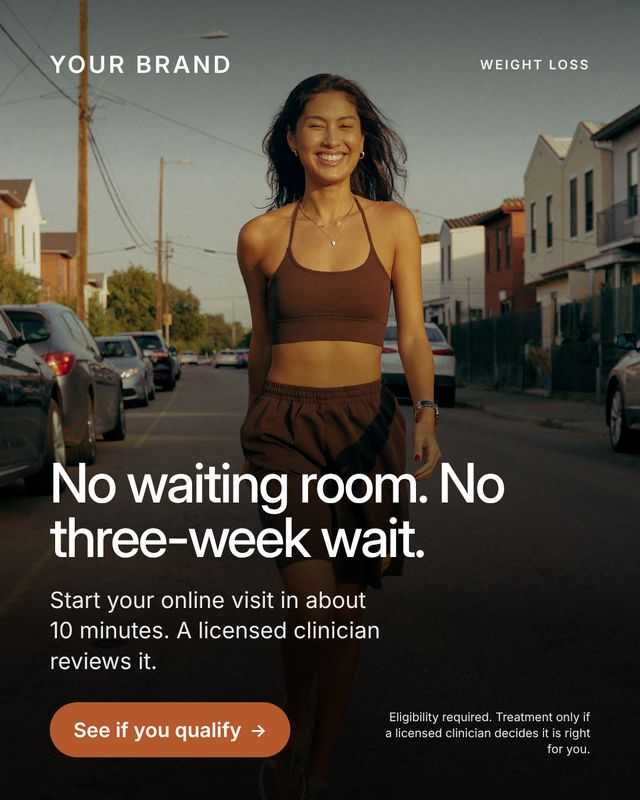
Five formats, each built around a different reason people hesitate: time, cost, what is included, complexity, and doing it alone. No bodies, no scales, no before-and-after, no promised pounds.


We say
- If a clinician decides it is right for you
- Eligibility required
- Plans start at [price] a month
- Results vary from person to person
- Medication only if prescribed
We never say
- Lose 30 pounds in 30 days
- Guaranteed results
- Same as a brand name drug, FDA approved, when it is compounded
- Before and after photos or promises
- Anything that targets or names a person's weight or body
Spec creative for a fictional brand, built to show the format. The people are AI-generated and would be labeled as each platform requires. Real campaigns use your brand, your approved claims and your review.
What weight loss patients actually say.
Every week AI reads competitor GLP-1 ads, reviews and patient communities and ranks the angles nobody is using. A typical output looks like this.
| Angle | What patients say | Competitor gap | Hook |
|---|---|---|---|
| Price upfront | "Every site makes you do the whole intake before showing the price." | Price hidden until after intake | See your price before you start. |
| Real follow-up | "I got a prescription and never heard from anyone again." | One visit, then silence | Check-ins that keep going. |
| No judgment | "I did not want to explain my weight to another doctor in person." | Clinical, impersonal copy | Start online, on your own time. |
| Supply worries | "I want to know my refills will actually show up." | Few mention delivery reliability | Delivered to your door, every month. |
Illustrative example of the output format, not research findings.
Test, scale, return. One treatment line first.
Meta removed health-related interest targeting in 2022, so the creative does the targeting. Structure keeps testing and scaling apart so winners are proven before budget moves.
| Campaign | Objective | Audience | Budget share |
|---|---|---|---|
| Testing | Sales or instant form leads | Broad, licensed states only | 20 to 30% |
| Scaling | Sales, Advantage+ | Broad plus Advantage+, proven ads only | 60 to 70% |
| Retargeting | Sales | Site visitors and engagers, never intake pages | About 10% |
Before any of this: prescription drug advertising on Meta and Google generally requires certification, commonly through LegitScript. Start the application before building campaigns, because approval can take weeks.
Refills are the business. Build them before you scale.
GLP-1 economics depend on month three. These flows run on pharmacy and payment events and keep patients from quietly dropping off.
Texts never name the medication. Anything about side effects goes straight to the clinical partner.
Live in 14 days.
What a GLP-1 launch looks like when certification and the storefront are ready.
| When | What happens |
|---|---|
| Days 1 to 5 | Claims rulebook and messaging, CRM and HIPAA setup, texting registration, server-side tracking |
| Days 6 to 10 | First AI ad batch approved, speed to lead and abandoned intake flows built |
| Days 11 to 13 | End-to-end test: a test lead from a Meta form to the first text to a test purchase back to Meta |
| Day 14 | Testing campaign and follow-up live |
| Weeks 3 to 6 | Scaling campaign and refill, payment and save flows live |
Related deep dives: AI in healthcare marketing, telehealth patient acquisition, clinical trial recruitment.
Get 5 AI ads for your brand. Free.
We research your market and send back five finished ads in your brand, with the angle behind each one. See real examples on AI ads for healthcare.
Get my 5 free ads
Straight answers
How do GLP-1 telehealth companies advertise without getting banned?
How do medical weight loss clinics get more patients?
What is a good cost per patient for a GLP-1 program?
What does weight loss clinic marketing cost?
Do you need LegitScript to advertise GLP-1 medications?
Can you advertise compounded semaglutide or tirzepatide?
What GLP-1 ad angles work best?
How do GLP-1 brands keep patients past month two?
Related guides
Test your own intake tonight.
Send us one service line. We inquire the way a real patient would tonight, time the reply, and show you the thread the agent would have sent. Free, two business days.
Book your 30-minute callGo deeper: telehealth marketing for cash-pay brands, HIPAA-compliant tracking, lifecycle email and SMS, AI marketing automation, and the marketing stack.